
This week we come to the second of the three Lenten Encounter Stories within Year A of the Lectionary Cycle of three years.
Last week the Gospel passage told how Jesus encountered the Samaritan Woman at the Well. This week he encounters the man who is blind from birth. Next week we will read how he makes his way to Bethany for an encounter there with Martha and Mary - the sisters of the deceased Lazarus - before he enters Jerusalem for his encounter there with Pontius Pilate and others.
This week's encounter within the Gospel is looked upon as one of the masterpieces of John's Gospel. Jesus is leaving the Temple after celebrating the Feast of Tabernacles - The Hebrew Feast which celebrates the Temple as the light of all Jerusalem and of the Law [of Moses] as the lamp and the light which lead to God. He meets a man who has been blind since birth. He cannot see.
Fourth Sunday in Lent (Year A)
Sunday, 3 April 2011
Our Shepherd-King in this Valley of Darkness
We walk in the darkness of this world,often assailed by fear and misgiving. But Christ, the Shepherd-King, the second David, lights up our way for us and cures our congenital blindness as he leads us to his kingdom.
Readings:
Samuel 16: 1. 6-7. 10-13
Psalm 22
Romans 5: 8-14
John 9: 1-41
Scripture Reflection
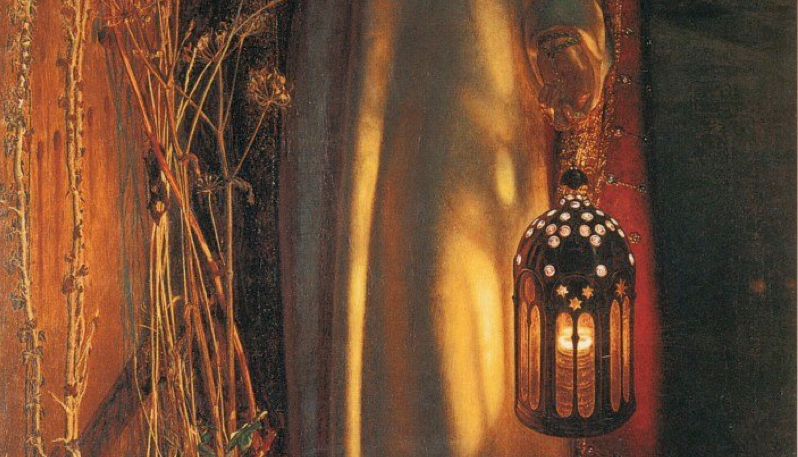
Do we prefer to live in darkness rather than in light?
Do we prefer to judge superficially rather than profoundly?
Do we arrogantly look down at other people, dismissing what they say when this does not fit well with long established and "set in stone" views?
What will cause us to live our lives openly in the light and in goodness rather than in the shadow of darkness and sin?
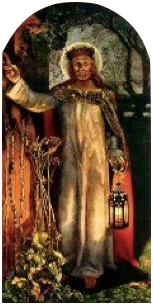
The first and the second readings today have already highlighted how those who are not blind often cannot see either. They either look at and are taken in by appearances - things which are superficial - while God sees beyond the superficial and into the heart; or they cannot see because they live in darkness and do things in secret and not in the light. The prophet Samuel anoints David as king; the youngest and least physically impressive of the sons of Jesse. Paul, in the Letter to the Ephesians, calls on the Christians in Ephesus to live as children of the Light [of Christ].
The man who is born blind represents all who are born in Original Sin. We are like him because we are born into darkness through original sin and brought into the light through baptism in Jesus Christ. We are called in the prayer of Baptism to live always in that light. The man who is born blind is given sight without ever asking Jesus for anything and moves through faith to being able to see and understand the identity of Jesus. The Pharisees, although having physical sight, are unable to see or understand who Jesus is and persist with questions which show their prejudice, their closed mindset and their arrogant dismissal of the faith testament of the blind man. The one who knows very little, the blind man, comes to know and declare much to others through his response in faith but the ones who know much, the Pharisees, learn nothing about Jesus.
Last week, the Samaritan villagers of Sychar come to believe in Jesus through the testament and witness of the woman from the village. She meets Jesus at the Well where he offers her water, which will satisfy her thirst forever, and speaks to her about her history and about how she leads her life. This week, the Pharisees do not come to faith in Jesus; despite all they learn that Jesus has done for and given to the blind man. He even asks them if they too wish to become disciples of Jesus. The blind man puts the apparent contradiction to them: "He has opened my eyes and you don't know where he comes from....if this man wasn't from God he couldn't do such a thing." The prejudices of the Pharisees and their arrogance, "Are you trying to teach us?" prevent them from moving from blindness to sight. The religious authorities show themselves to be more interested in correct theology than in the gift of healing, which has been given before their very eyes to the man who was born blind. Jesus is deemed to have broken the Sabbath by his gift of healing.
Spirituality is about living by discerning and embracing truth. Sin is about living as if one is blind. Sin is a closed mindset; it is a refusal to grow. The hope of the Church is that by thinking about these three encounters in weeks three, four and five during Lent, we will wish to examine our own way of living. All of the encounters are presented in the Gospel passages as the coming together of two people, or between one person and a group of persons, or as between two groups: Jesus and the blind man, twice; the blind man and the Pharisees, three times; the Pharisees and the parents of the blind man, once. This is a very significant element of the Gospel passages. It shows an intimate level of relationship between God and us which gives rise to important questions.